Embed AI in Business Software: 4 Concrete Cases (Without Rewriting Everything)
Useful AI is not a generic chatbot parked next to the business. Here are four concrete ways Codally embeds it in the work — vision, privacy, customer service and processes.
To embed AI in business software, start from a repetitive task that already costs you (surveillance, reception, data entry, post-production), connect the model to the tools your teams already use, and keep a human in the loop as soon as the case leaves the playbook. You do not need to rewrite the whole system: AI plugs into the existing flow, where it absorbs volume and frees time.
Key points
- Profitable AI latches onto an existing process; it does not replace a business system overnight.
- Four families of cases we deliver: vision (detection), privacy (blurring), conversation (WhatsApp / phone) and process automation.
- The decisive safeguard: AI handles predictable volume; a human takes over on doubt, urgency or exceptions.
This is not "doing AI". It is removing friction.
Many AI projects fail because they start with the technology: a model, a demo, a slide deck. At Codally we invert that. We start from a real bottleneck — a front desk that can no longer pick up, cameras that record without alerting, construction quotes still typed by hand — then we ask: which part of this task can a model absorb without breaking the rest of the work?
The answer is almost never "rewrite everything". It is to plug an AI brick into the calendar, the camera feed or the spreadsheet already in place, and ship a first result in a few weeks.
Case 1 — Vision: detect what a human cannot watch 24/7
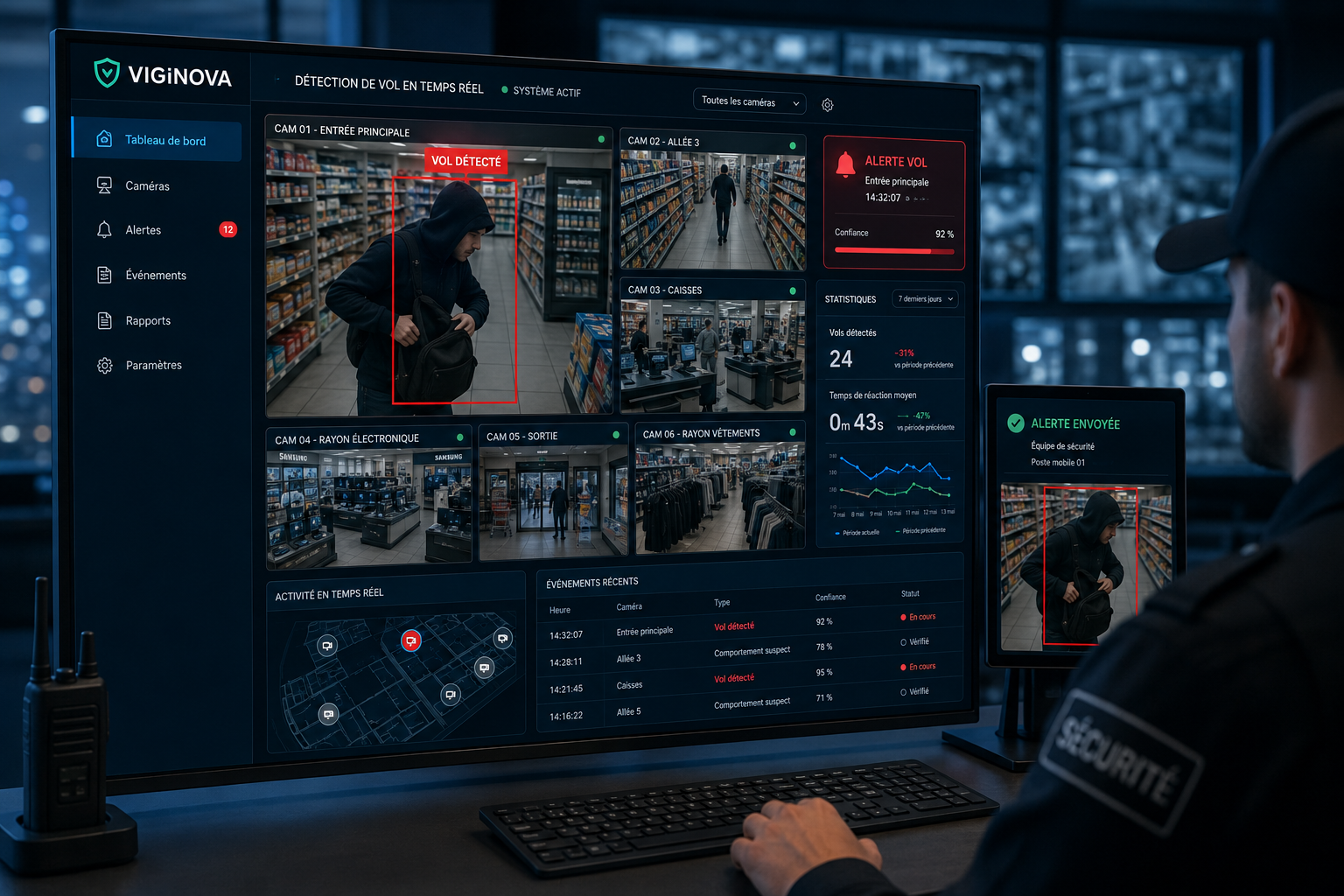
With VigiNova in Montreal, the problem was not a lack of cameras. Classic video surveillance notices theft after the fact. An operator cannot watch every feed continuously, and 24/7 human monitoring is prohibitively expensive.
We designed a computer-vision model that analyses live or recorded feeds, detects theft, intrusions and abnormal behaviour, and alerts the teams. The monitoring app stays the agents’ tool: AI does not replace them, it shows them where to look.
What changes in practice:
- continuous feed analysis, day and night;
- targeted alerts instead of hours of after-the-fact viewing;
- faster reaction time, and fewer incidents noticed too late.
Case 2 — Privacy: blur without spending hours on it
Flouter AI, an internal Codally project built with media teams, is as much a legal problem as a production one. On a street report, every passerby in frame is a face to anonymise. Manual blurring is slow, expensive, and a single miss creates risk (image rights).
The model detects people, classifies roles (journalist, interviewee, passerby) and blurs selectively. The subject stays sharp; passersby disappear. AI slots into the post-production workflow: we do not invent a new editing suite, we accelerate a step that was already mandatory.
Case 3 — Conversation: a front desk that no longer rings into the void
At the Lavicennes Medical Group (Bulle, Switzerland), reception was drowning in repetitive calls — hours, availability, reminders — and losing patients after closing time. Instead of yet another app to install, we put an assistant on WhatsApp, the app everyone already has.
It books on real calendar slots, answers administrative questions, sends reminders, and hands off to a human as soon as a request leaves the playbook — especially in healthcare. In health, what the assistant does not do matters as much as what it does: no diagnosis, no invention, emergencies redirected to emergency services.
Results observed on this kind of rollout:
- a majority of routine requests handled without staff;
- appointments finally booked in the evening and on weekends;
- fewer no-shows thanks to automatic reminders;
- a front desk that gets time back for in-person welcome.
Case 4 — Process: leave Excel without breaking everything
A large part of our work does not wear an "AI" label at first glance: construction quantity calculators, inventory management, inspections, clinic billing. These are business systems that replace spreadsheets, double entry and copy-paste errors.
AI comes next, where there is material: extracting data from a quote, classifying inspection photos, suggesting a quantity from history. The software is the foundation. AI is a layer, not the product.
How we decide whether a use case is worth it
Before writing a line of code, we ask four questions. If one of them has no clear answer, we do not launch a model: we start smaller.
- Is the task repetitive, measurable, and already costly (time, errors, missed calls)?
- Do the data already exist, in a tool the team actually uses?
- What happens if the model is wrong — and can a human take over in seconds?
- Can we ship a first useful version in a few weeks, without rewriting the whole system?
Frequently asked questions
Do you need to rewrite everything to add AI to business software?
No. The projects that work plug an AI brick (vision, conversation, extraction) into a calendar, a camera feed or existing software. Rewriting the whole system is only justified if the current foundation is actually in the way.
What is the difference between a generic chatbot and a business assistant?
A generic chatbot answers "in general". A business assistant reads and writes in your tools (calendar, stock, CRM), stays inside a defined perimeter, and escalates to a human outside it. That integration — not the language model — creates the value.
Can AI give medical or legal advice?
At Codally, no. On healthcare projects the assistant is strictly administrative: appointments, reminders, opening hours. Any clinical request, emergency or doubt is handed to a person. The same principle applies whenever the stakes are sensitive.
How long does a first use case take?
A first useful rollout is often delivered in a few weeks when the process is clear and the data is accessible. The Lavicennes WhatsApp assistant, for example, went from idea to production in about eight weeks.
Where do we start if we have no internal data team?
With a single use case, high volume and low risk. Codally acts as an external tech team: we scope the problem, ship a testable increment, measure, then expand. You do not need an IT department to start.
Takeaway
The AI we build is not a gadget: it is a layer on real work — cameras, reception, job sites, post-production. We start from friction, latch onto tools already there, and keep humans on exceptions. That is how an SMB actually automates, without rewriting everything.

Need support?
Codally can help you integrate these solutions into your business.