Revised Federal Act on Data Protection, in force since 1 September 2023.
Case study · Healthcare
A clinic that never lets the phone ring out
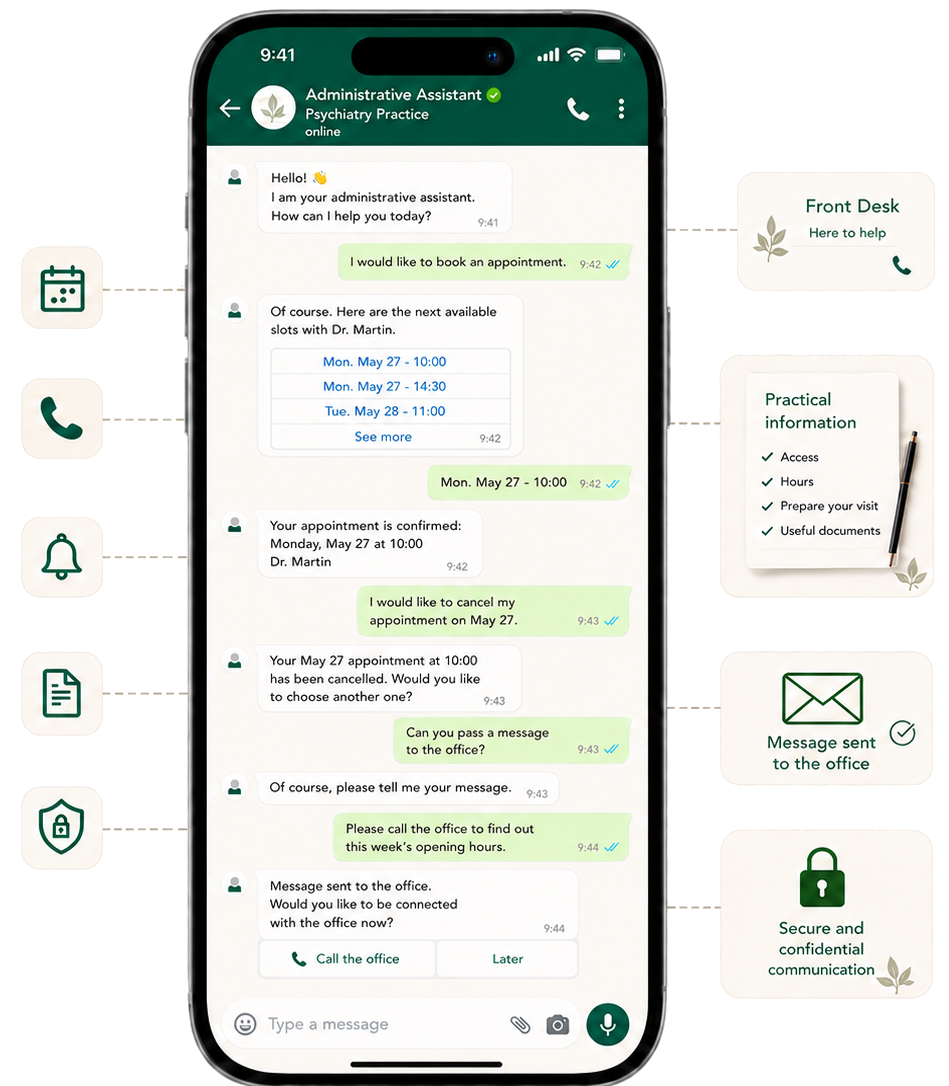
In Bulle, the front desk at Lavicennes Medical Group was drowning in repetitive calls and losing patients whenever the clinic was closed. We designed an intelligent WhatsApp assistant that books appointments, answers common administrative questions and sends reminders automatically, around the clock. The moment a conversation goes beyond admin, it hands off to a person.
−37%fewer missed appointments
67%of requests handled without staff
24/7self-service booking
< 30saverage response time
At a glance
- Client
- Lavicennes Medical Group
- Industry
- Healthcare · Private clinics
- Region
- Switzerland (Bulle, canton of Fribourg)
- Services
- Product design · Conversational AI · Integration
- Stack
- WhatsApp Business API · n8n · Mistral AI · Node.js
- Time to launch
- ≈ 8 weeks from idea to production
The problem
The challenge
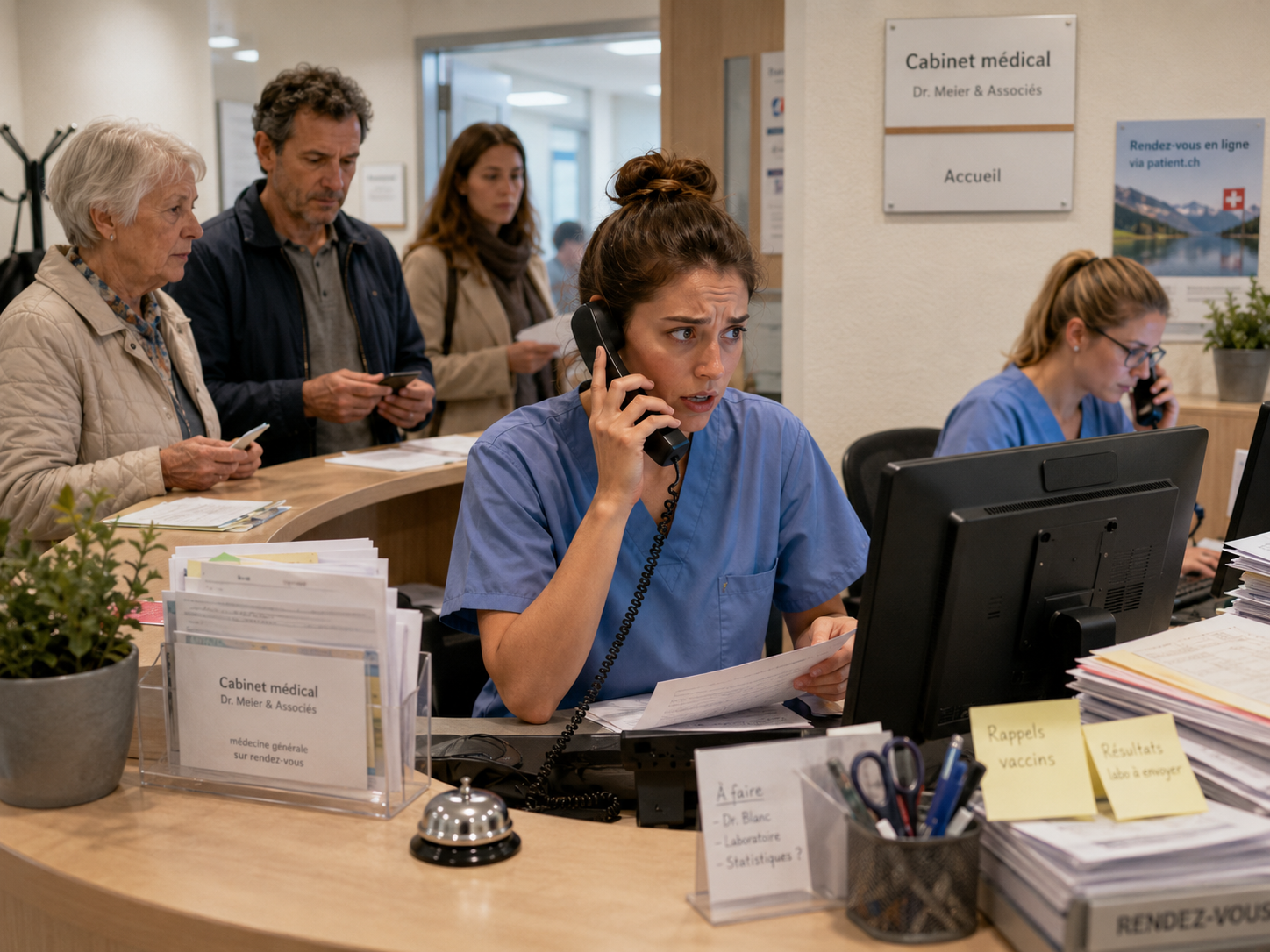
Like many clinics, Lavicennes ran the entire patient relationship over the phone. At peak hours the front desk handled call after call for simple, repetitive requests, while other patients waited on hold or hung up. And once the clinic closed, no one was left to answer: every evening and weekend, requests simply fell through the cracks.
- A front desk monopolised by repetitive questions (hours, availability, access, exam preparation).
- No way to book outside opening hours, so patients were lost every evening and weekend.
- Missed appointments due to unreliable reminders, and therefore wasted slots.
- A response time of several hours that hurt the patient experience.
The solution
Our approach
Rather than adding yet another channel, we spent time with the front desk to map the real patient requests and pinpoint the many that could be handled without a human. We then built an assistant on WhatsApp, the app everyone already has. It handles simple administrative cases on its own and hands off to a person the moment a request falls outside that scope.
- Conversational booking, with real availability read and confirmed in the clinic’s calendar.
- Instant answers to frequent administrative questions, written together with the medical teams.
- Automatic reminders 24h and 2h before the appointment, with one-message rescheduling.
- Smart hand-off to a human as soon as a request falls outside the administrative scope.
How it works
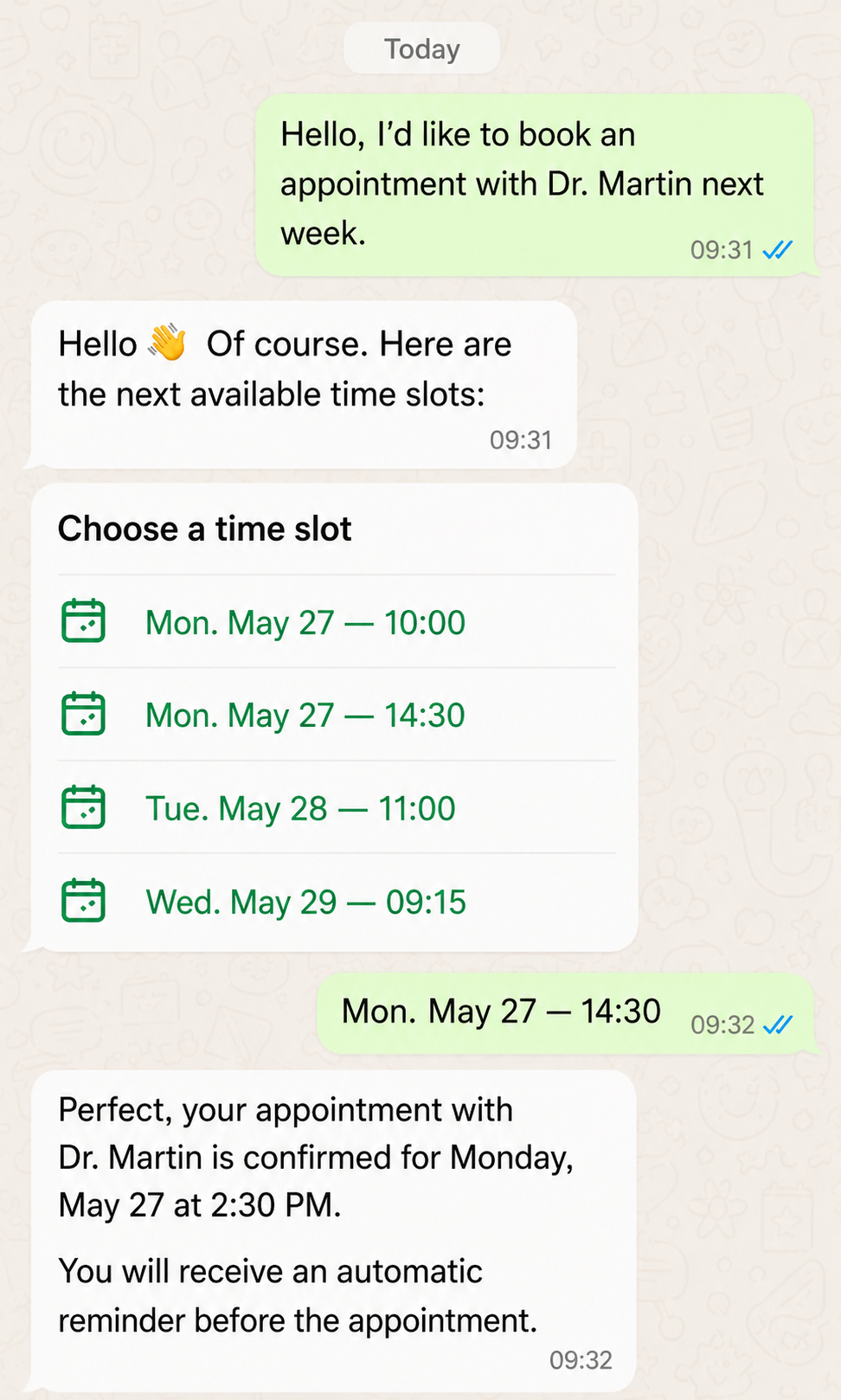
- 1The patient writes
They send a simple WhatsApp message, any time, with no app to install and no account to create.
- 2The assistant understands
The AI detects the intent (booking, administrative question, reschedule) and replies in natural language.
- 3The slot is confirmed
Real availability is offered then locked into the calendar, with instant confirmation.
- 4Reminders run themselves
The patient gets automatic reminders and can reschedule in one tap. The front desk only steps in when needed.
Team side
On the clinic’s side
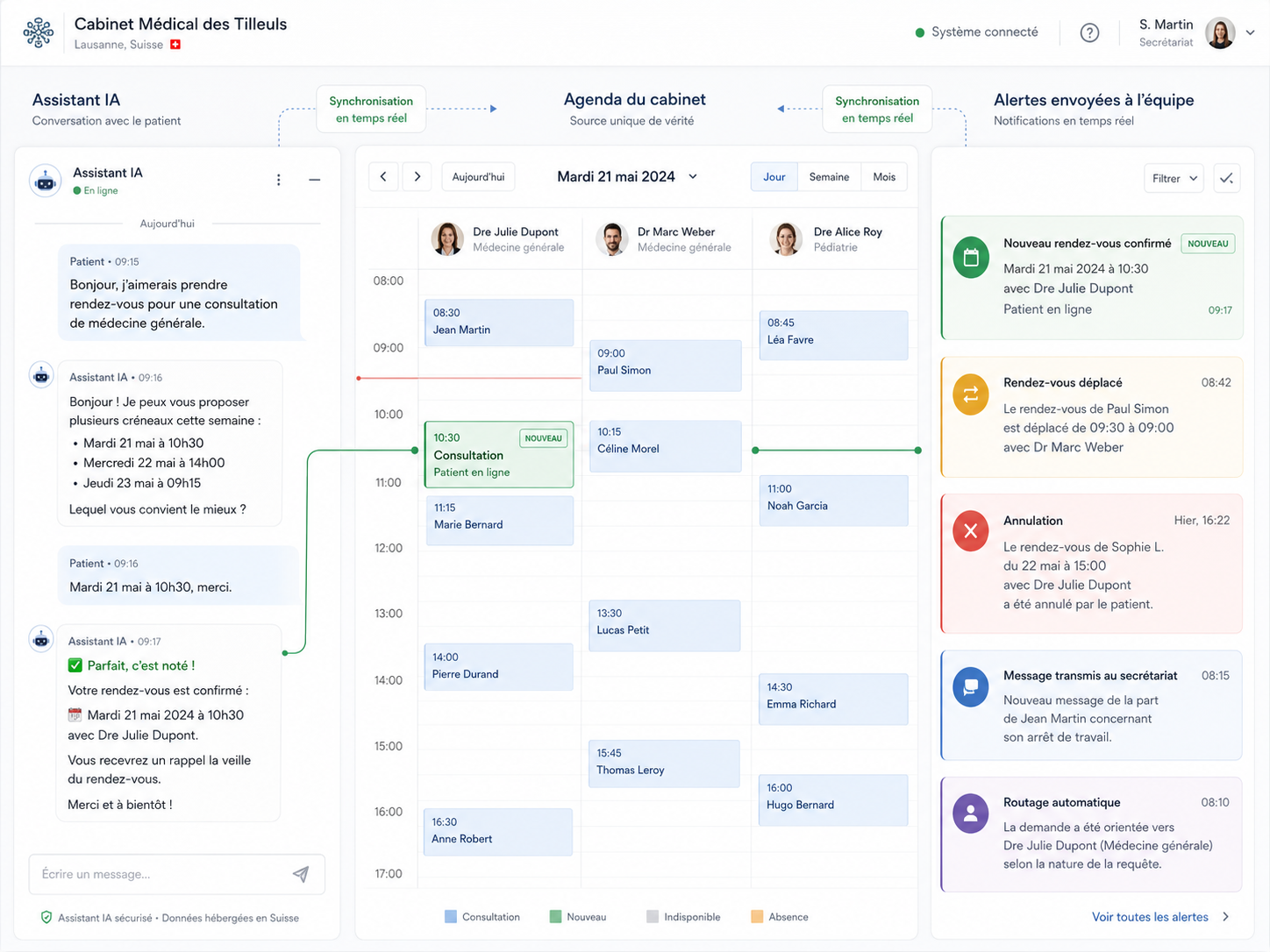
The assistant doesn’t live on its own: it is synced in real time with the clinic’s calendar, which remains the single source of truth. Every booking, reschedule or cancellation is reflected instantly, and the right people are alerted automatically based on the internal organisation, with no double entry and no risk of double-booking.
- Calendar synchronisation
Slots are read and written straight into the clinic’s calendar: real availability, instant updates, zero double-booking.
- Alerts to the right people
Every new appointment, reschedule or cancellation triggers a notification sent automatically to the people concerned.
- Routing by organisation
Requests are directed to the right practitioner or front desk based on the reason and the clinic’s internal organisation.
- Messages forwarded
Messages left by patients are logged and forwarded to the front desk, ready to be handled at the right time.
- No double entry
Everything is centralised: the team keeps its usual tools, with no re-keying of information from one system to another.
The results
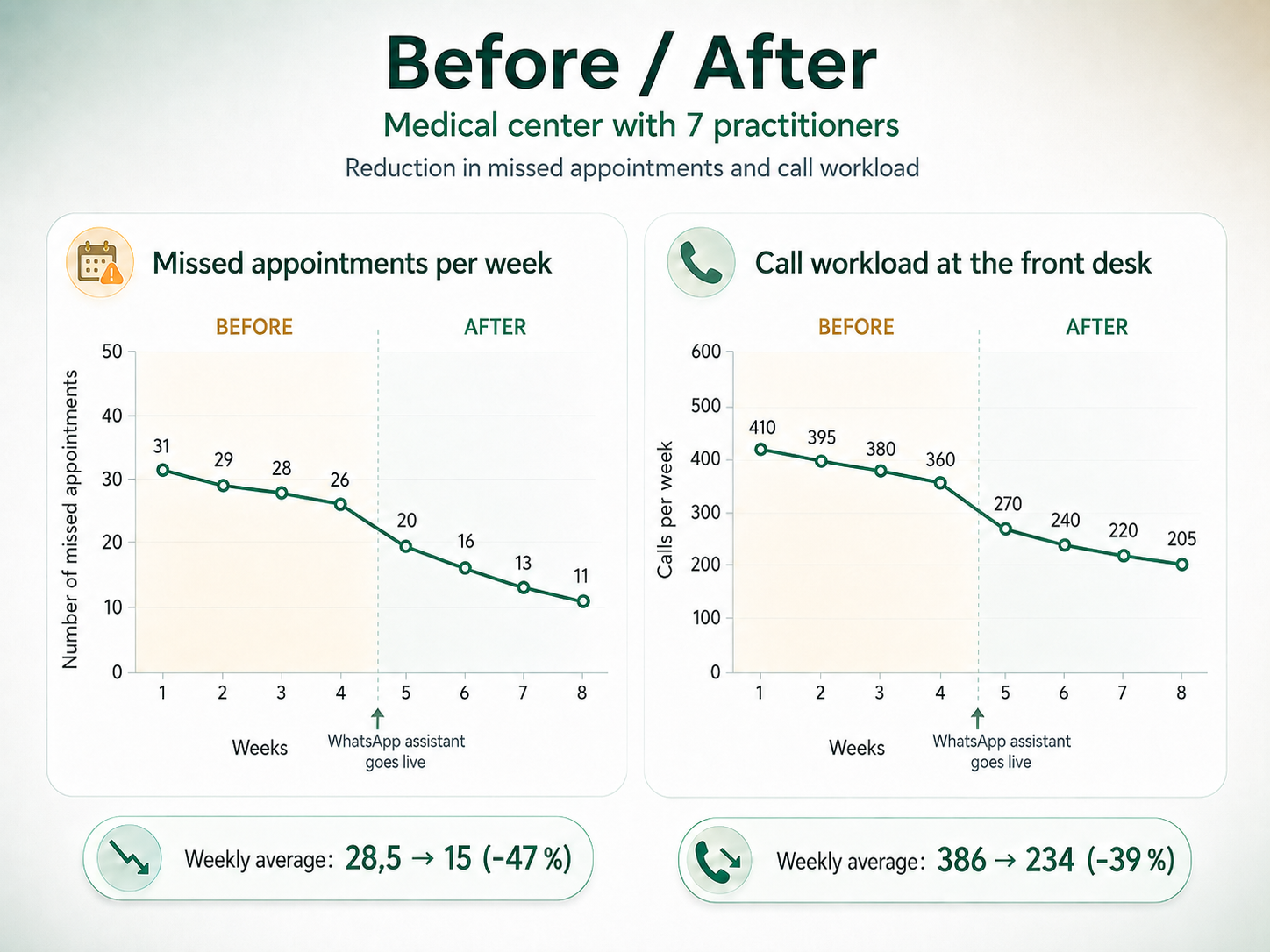
Within the first weeks, the assistant absorbed most routine requests and gave the front desk time back for what truly matters: welcoming patients in person.
−37%fewer missed appointments thanks to automatic reminders
67%of routine requests handled without any staff
43%of bookings made outside opening hours
< 30sto a first reply, versus several hours before
Before / after
| Metric | Before | After |
|---|---|---|
| First response time | ≈ 4 h | < 30s |
| Missed appointments | 23% | 14% |
| Bookings outside hours | 0% | 43% of bookings |
| Time to book | ≈ 4 min (phone) | ≈ 1 min (WhatsApp) |
| Front-desk call load | High | −61% |
Guardrails
How the assistant behaves
In healthcare, what the assistant does not do matters as much as what it does. Its scope is strictly administrative, and its behaviour rules were defined with the medical teams to keep patients safe.
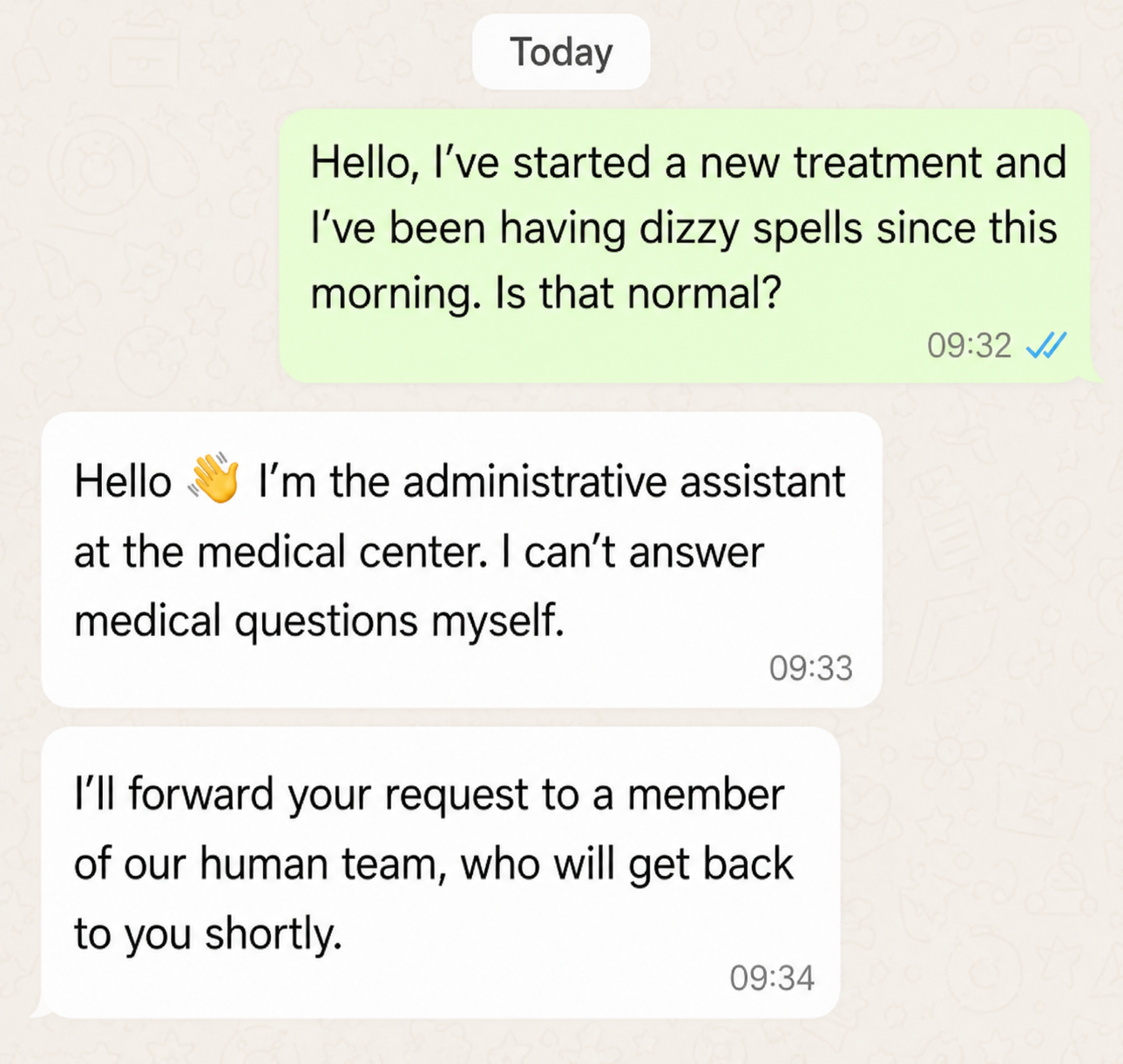
- No medical advice
The assistant never diagnoses and never offers medical advice on its own initiative.
- Hand-off to a human
Any request beyond admin is routed to the front desk; patients can also ask for a human at any time.
- Emergencies redirected
At any sign of an emergency it immediately points to 144 (emergency services) or the medical hotline, without trying to handle the situation.
- No making things up
When uncertain or low-confidence, it escalates to a person rather than guessing.
- Transparency
Patients know from the start that they are talking to an automated assistant, not a clinician.
Our patients get an instant reply even when the clinic is closed, and our front desk finally has time for in-person care. Missed appointments have dropped significantly.
Security & compliance
Health data is sensitive data: it leaves no room for compromise. The assistant was built with end-to-end encryption, data minimisation and compliant hosting, in strict compliance with the Swiss and European legal frameworks that govern patient data.
Health data treated as a special category (Art. 9), for patients residing in the EU.
- End-to-end encryption
All WhatsApp conversations are encrypted via the Signal protocol.
- Data minimisation
Only the information strictly needed to book an appointment is collected and processed.
- Compliant hosting
Data hosted and processed in Switzerland or the EU, with no transfer outside that perimeter.
Tech stack
Still running everything by phone?
Let’s talk about the assistant that could relieve your teams and smooth out your customers’ experience.