AI phone assistants, deployed custom-built for each client
We designed, built and shipped intelligent phone assistants for several companies across very different industries. Request triage, phone callbacks, answers to common questions: each deployment was custom-built to fit the client’s business processes, because no two businesses work exactly alike.



No generic solution
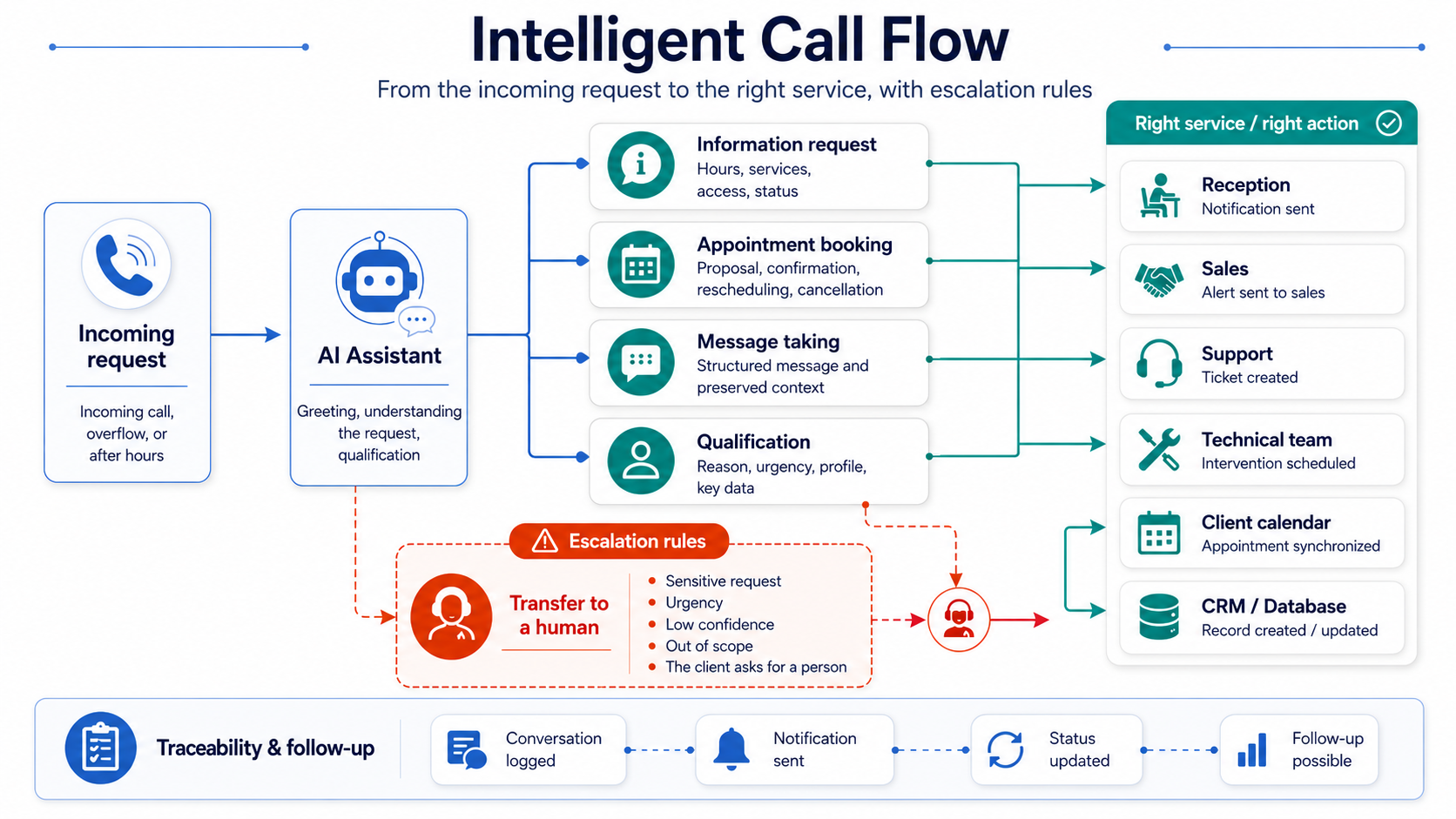
On each of these projects we started from the client’s real processes rather than a standard script. A medical practice doesn’t handle calls like an engineering firm, a distributor or a technology company: the requests, the business vocabulary, the escalation rules and the internal tools are all different. That’s why each assistant was custom-built and integrated into the company’s existing workflow.
- Built around each client’s business processes.
- Integrated with existing tools (calendar, CRM, database).
- Tone, languages and escalation rules defined with the client.
- Maintained and improved once in production.
They’ve already rolled it out
Four companies, four trades, four different assistants. The same technology foundation, adapted to each operational reality.
An assistant to smooth out patient call handling and relieve the medical front desk.
- Patient call triage
- Appointment booking & confirmation
- Reminders and fewer no-shows
An assistant to take in job-site requests and route every call to the right team.
- Incoming request triage
- Job-site information and follow-up
- Hand-off to the right contact
An assistant to qualify incoming requests and provide a first answer before escalation.
- Incoming request qualification
- First-level answers
- Escalation to the right team
An assistant to screen calls, structure messages and keep case follow-ups on track.
- Call screening and triage
- Structured message taking
- Reminders and case follow-ups
The building blocks we put in place
On these projects we assembled the following capabilities around each client’s needs. An assistant may use just one or combine several within a single call flow.
- Request triage
The assistant understands the reason for the call, categorises it and routes it to the right team or person.
- Phone callbacks
Automated reminders and callbacks (appointments, payments, follow-ups) placed at the right time, at scale.
- Information requests
Instant answers to frequent questions: hours, services, access, order or case status.
- Appointment booking
Offers, confirms, reschedules or cancels slots while syncing with the client’s calendar.
- Lead qualification
Collects the key information, qualifies the opportunity and hands it to the right team.
- Hand-off to a human
Passes the call to the right person with full context whenever a situation calls for it.
- Messages to the right team
Logs and forwards messages to the relevant team: nothing is lost, everything is tracked.
- Call overflow
Takes over at peak times and outside hours so the phone never rings out again.
How we delivered these projects
- 1Map the processes
For each client, we analysed real calls, frequent cases and business rules before writing a single line.
- 2Design the call flow
Scenarios, tone of voice, languages and escalation rules were defined with the client, then prototyped.
- 3Integrate existing tools
We connected the assistant to the client’s calendar, CRM or business database.
- 4Ship & improve
Gradual rollout, monitoring of real conversations and ongoing fine-tuning.
The profiles this kind of project makes sense for
What our clients share isn’t their industry, but a phone that rings too much, too often for repetitive requests, or one that goes unanswered for lack of availability.
- Clinics & medical practices
- Retail & distribution
- Technology companies
- Engineering & design firms
- Service SMBs & trades
- E-commerce & after-sales support
- Law & accounting firms
- Switchboards overwhelmed at peak hours
Does your phone ring more than you can answer?
Let’s talk about your call flow and the process we could automate, custom-built, just like we did for our clients.